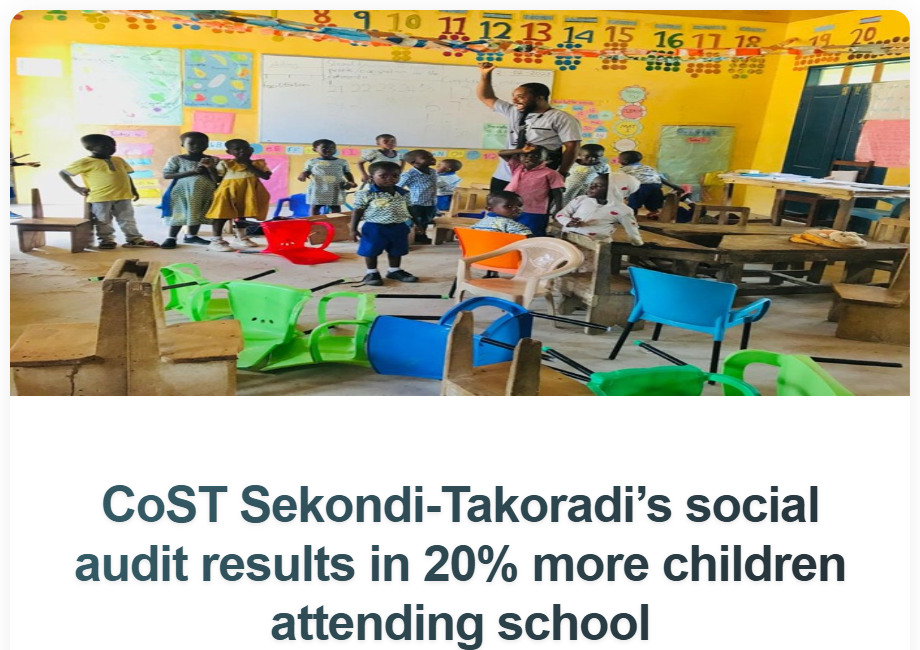
The Sekondi-Takoradi Metropolitan Assembly’s (STMA) social audit under CoST offers a compelling demonstration of how genuine community engagement and transparency can transform public infrastructure outcomes. By organizing and training a diverse citizen monitoring team—including civil society groups, media, disability advocates, and government representatives—STMA confronted long-standing deficiencies in two critical projects: a school block that had been rendered unusable due to lack of furnishing and mis-use, and a non-functional fire station with safety and accessibility defects. The social audit did not just uncover these failures; it generated actionable recommendations that were implemented, resulting in a 20 percent increase in school attendance and the operationalization of the fire station with improved emergency response capacity and stronger community safety. This experience is more than a local success story—it is a strategic critique of conventional infrastructure delivery in Ghana and beyond. It underscores that transparency and accountability are not abstract reforms but practical tools that yield measurable social benefits when anchored in citizen participation and responsive governance. Yet it also speaks to a broader structural issue: without institutionalizing mechanisms like social audits, many public projects risk misalignment with community needs, perpetuating waste and exclusion. STMA’s approach should not be seen as an isolated experiment, but as an essential model for scaling participatory scrutiny into national infrastructure policy and practice if governments are serious about accountability, inclusive development, and maximizing the social value of public investments. CREDIT: CoST International